
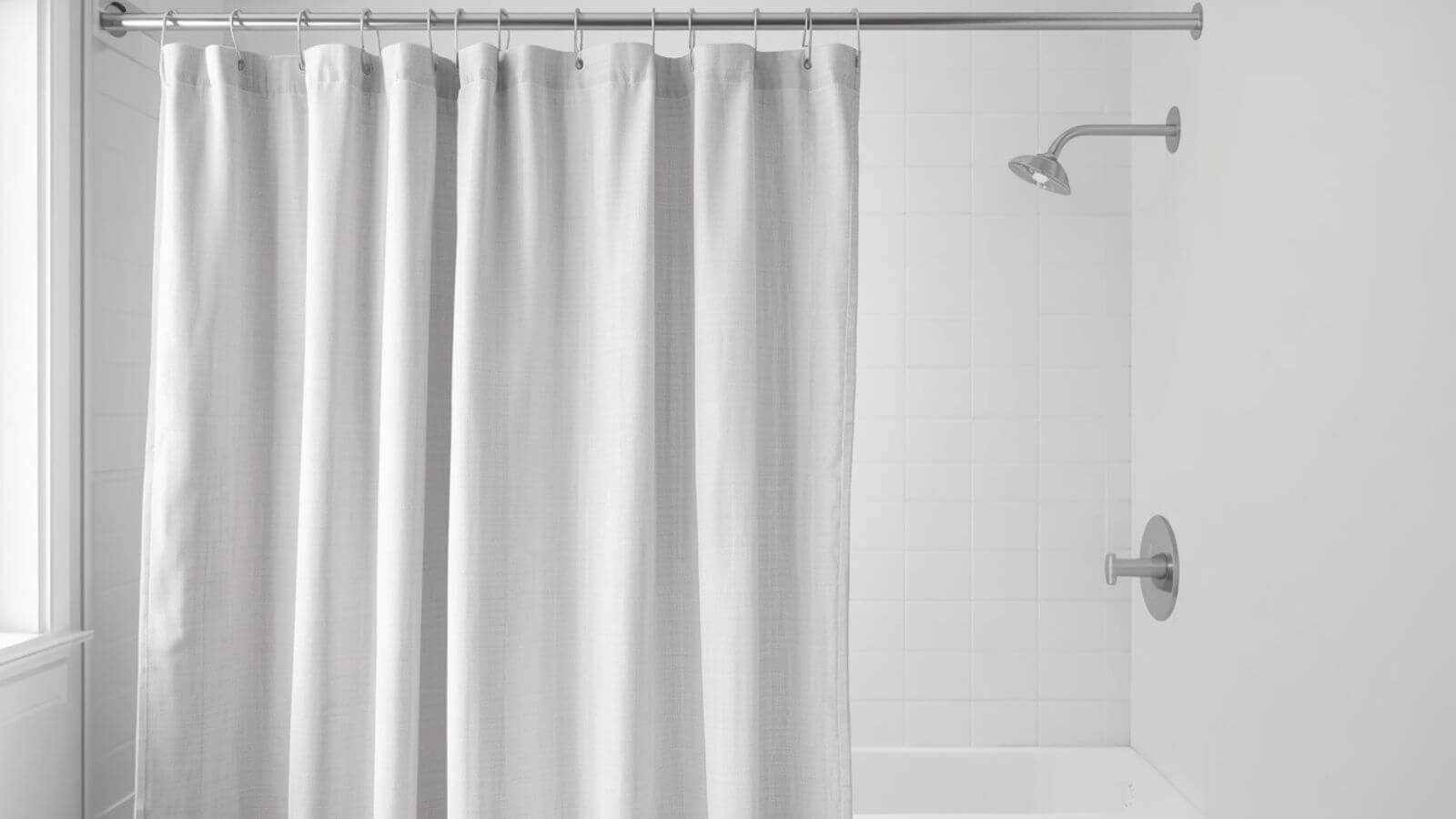
What Is the Standard Shower Curtain Size?
The standard shower curtain size is 70 inches wide by 72 inches long. That’s the size stocked on the shelf at Target, Walmart, Bed Bath & Beyond, and almost every other retailer that sells shower curtains, and it’s cut to fit a standard 60-inch tub or shower opening with enough slack to hang in soft folds instead of pulling flat against the wall.
Some brands round up to a full 72 x 72 inch square instead. Both are marketed as “standard,” and in practice the one-inch difference rarely matters — it just changes whether the curtain sits closer to the tub or has a touch more drop.
Not every shower is standard, though. A stall, a clawfoot tub, and a walk-in each need a different size, and the chart below covers all of them.
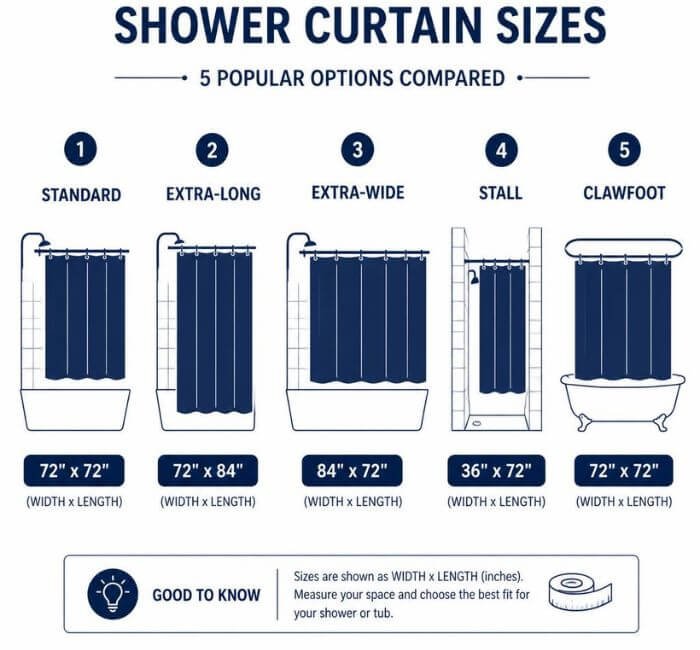
Standard Shower Curtain Size Chart
Shower Type | Width x Length (inches) | Width x Length (cm) |
Standard tub/shower | 70″ x 72″ (also sold as 72″ x 72″) | 178 x 183 cm |
Extra-long / extra-tall | 70-72″ x 84-96″ | 178-183 x 213-244 cm |
Extra-wide (curved rod) | 108-144″ x 72″ | 274-366 x 183 cm |
Shower stall | 54″ x 78″ | 137 x 198 cm |
Clawfoot / freestanding tub | 54-72″ x 72″ (wraparound) | 137-183 x 183 cm |
RV / compact bathroom | 48-60″ x 60-65″ | 122-152 x 152-165 cm |
Liner (standard) | 70″ x 72″ | 178 x 183 cm |
Manufacturers don’t all round the same way — you’ll see 70 x 70, 70 x 72, and 72 x 72 curtains all sold as “standard” size, sometimes by the same brand across different product lines. If you’re choosing between two sizes that are within an inch or two of each other, it genuinely doesn’t matter which you pick. Go bigger only when the difference is real, like choosing an extra-wide curtain for a walk-in shower instead of a standard one.
Where the 70 x 72 Standard Comes From
U.S. bathtubs settled on a 60-inch length as prefabricated tub-and-shower units scaled across postwar housing construction, and that measurement is still the default in most homes built since. A 70-inch-wide curtain gives roughly five inches of overlap on each side of a 60-inch opening, which is enough to keep water from splashing out at the ends without the curtain looking oversized. The extra two inches of length beyond a curtain’s usual 70-inch drop account for the curtain rings and rod, so the hem still clears the tub floor instead of dragging in it.
This is why 70 x 72 shows up as the default almost everywhere: it’s not an arbitrary number, it’s built around the tub size that most American bathrooms actually have.
How to Measure Your Shower for the Right Curtain Size
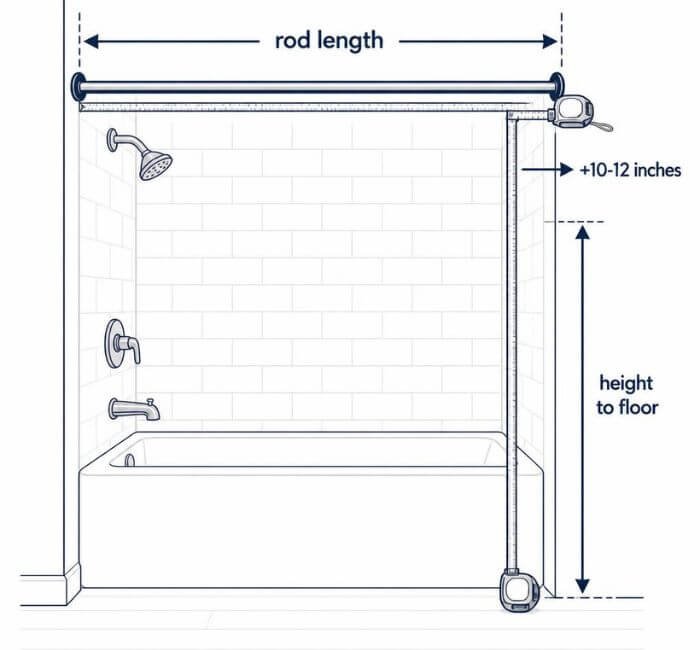
Four measurements settle this in under five minutes:
- Measure your rod length, wall to wall, or the width of the shower opening if the rod isn’t installed yet.
- Add 10 to 12 inches to that number. This is the total curtain width you’re shopping for. Use a flat addition, not a multiplier — doubling the rod length works fine on a straight standard rod, but it badly overshoots on a wide walk-in, where 1.5x to 2x could add two or three extra feet of fabric you don’t need.
- Measure the height from your rod down to the floor.
- Subtract 6 to 10 inches from that number for your curtain’s total length. That accounts for the rings and keeps the hem from pooling on the floor or dragging in the tub.
If your final numbers land between two standard sizes, size up. A curtain with a little extra width folds into soft pleats and looks intentional. A curtain that’s too narrow pulls flat against the rod and leaves gaps at both ends where water gets through.
Which Size Fits Your Shower?
- Standard tub/shower combo: 70 x 72″ fits almost every rectangular tub-shower unit without adjustment.
- Walk-in or stall shower: Go with 54 x 78″. There’s no tub lip to catch water, so the narrower, longer stall size hangs closer to the floor where it’s actually needed.
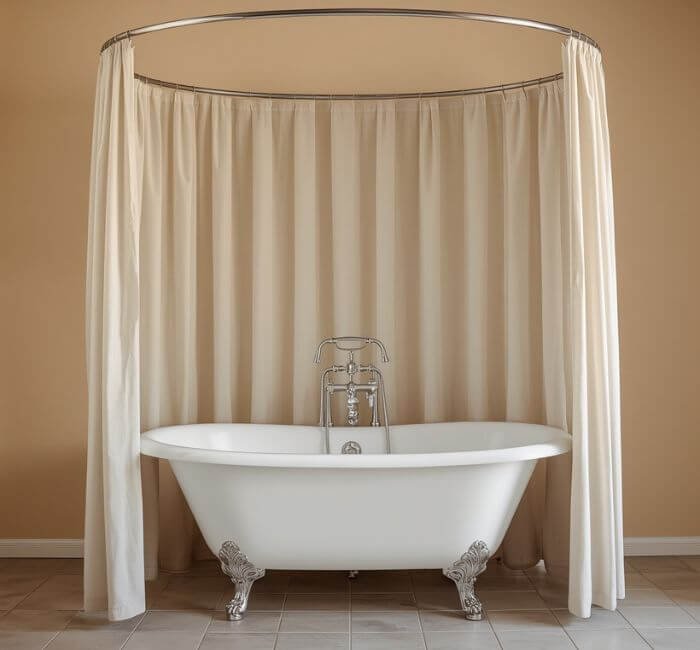
- Clawfoot or freestanding tub: You need an extra-wide, wraparound curtain (108″-144″) paired with an oval or curved rod that encircles the tub, not a straight one.
- High ceilings or a spa look: An extra-long curtain (84″-96″) keeps the proportions right instead of leaving a gap between a standard curtain and a raised rod.
- RV or small apartment bathroom: Compact sizes (48-60″ wide) avoid the bunched, oversized look a standard curtain gets in a tight space.
Shower Curtain vs. Shower Curtain Liner: Do the Sizes Match?
A shower curtain and its liner should be close to the same width, with the liner sized the same as or very slightly smaller than the outer curtain. The liner is the waterproof layer that actually stops water — it hangs on the inside, closest to the water — while the decorative curtain hangs outside it. If the liner is noticeably narrower than the curtain, water finds the gap at the edges.
Rod length is the other variable that has to match your curtain choice, not just your shower opening — a rod cut to the exact width of your tub won’t give a 70-inch curtain room to hang properly. Our rod size guide walks through the sizing math for adjustable, tension, and curved rods.
Shop by Size
Once you know your size, here’s what to search for:
- Standard (70″ x 72″): the safest default for any conventional tub or shower.
- Extra-long (84″-96″): for showers with 8-foot-plus ceilings or a floor-length look.
- Stall (54″ x 78″): for enclosed showers with no tub lip to catch overspray.
- Extra-wide (108″-144″): for curved rods around a freestanding or clawfoot tub.
Frequently Asked Questions
What is the standard shower curtain size?
The standard shower curtain size is 70 inches wide by 72 inches long, sometimes sold as a 72 x 72 inch square. Both fit a typical 60-inch tub or shower opening.
Is 70 x 72 or 72 x 72 more common?
70 x 72 is more common among budget and mid-range retailers, since it’s built around the standard 60-inch tub. 72 x 72 shows up more often in premium and hotel-style lines. Either fits a standard shower correctly.
What size shower curtain do I need for a walk-in shower?
Most walk-in showers need a stall-size curtain around 54 x 78 inches, since there’s no tub lip to catch splashed water and the curtain needs to hang closer to the floor. Measure your specific opening first, since walk-in showers vary more in size than standard tub-shower combos.
Should a shower curtain touch the floor?
No. Leave a half-inch to two-inch gap between the hem and the floor. A curtain that touches or drags on the floor stays damp, develops mildew faster, and can become a slipping hazard when you step out.
Do a shower curtain and liner need to be the same size?
They should be close in width, with the liner the same size as or slightly smaller than the outer curtain. This keeps the liner tucked inside the curtain rather than hanging past its edges.
What size shower curtain fits a clawfoot tub?
Clawfoot and other freestanding tubs typically need an extra-wide, wraparound curtain in the 108 to 144-inch range, hung from an oval or curved rod that encircles the tub. A standard 70-inch curtain won’t reach around a freestanding tub’s full perimeter.
Choosing Your Size
70 x 72 inches covers most bathrooms without any extra math. Measure first if your shower is anything other than a standard rectangular tub-shower combo — a stall, a clawfoot tub, or a walk-in each need a size built for that shape, and guessing usually means a return trip to the store.